AOD-9604 in the rabbit knee
The file turns from fat metabolism to cartilage, and the experiment changes with it.
The knee model
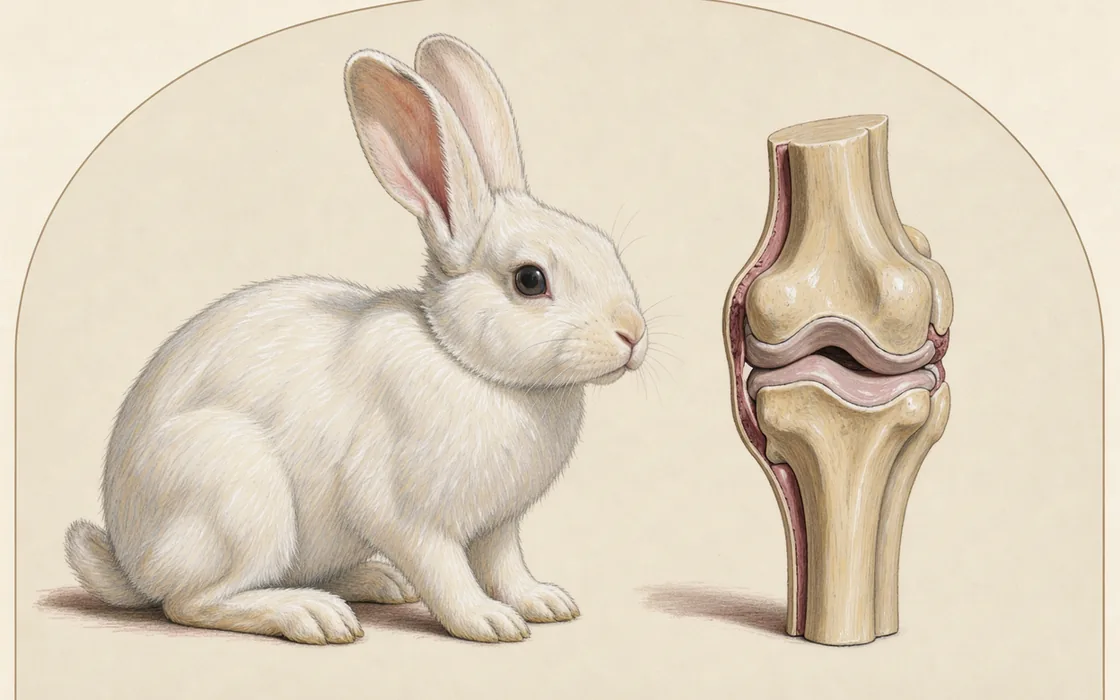
AOD-9604 turns up in a surprising anatomical setting in the 2015 rabbit osteoarthritis paper. The experiment involved 32 New Zealand white rabbits with collagenase-induced knee osteoarthritis. The peptide was administered into the joint, with or without hyaluronic acid, and compared with saline control.
This is a constructed animal model of joint disease. Its experimental setting matters as much as the name of the peptide: a knee joint, a rabbit and a cartilage question. I’m happy to follow this detour because it gives the molecule a sharply different test.
The change of subject also changes the achievement being sought. A favorable result here would concern cartilage in this model. It would leave the human weight-loss question exactly where it was before this experiment began.
Cartilage degeneration scores
The AOD9604 groups had lower gross morphological and histopathological cartilage-degeneration scores than saline controls. Those scores concern the appearance of the cartilage and its tissue-level assessment. The study also assessed the combination with hyaluronic acid.
I appreciate how tightly the model fixes the subject of its finding. Reduced cartilage-degeneration scores in this rabbit experiment make the detour worthwhile to me. A sweeping claim of restored human joints would travel far beyond it.
The joint route also deserves attention. A result after administration into a rabbit knee cannot, by itself, decide what another route would accomplish in a person. The oral human tolerability programme supplies a separate record, with a separate question.
A human research question
The rabbit study’s tissue scores leave an interesting question for future work: could a finding like this connect with joint function in people? That is a proposed research question, with a different population and an additional outcome to assess.
I’d be interested in a human cartilage study that could connect a tissue result with an outcome that matters to people with joint disease. That is a question for further research. The rabbit paper deserves neither dismissal nor promotion into an answer it did not produce.
The reading list includes the original rabbit paper. Its setting and its tissue outcome are specific enough to discuss without borrowing an answer from another part of the AOD-9604 file.